Logo Sciencesconf

Scientific Rationale

Nearby low-metallicity galaxies provide a crucial laboratory for understanding the interstellar medium, star formation, and feedback under conditions approaching those of the early Universe. Nowadays, modern facilities, such as the JWST, are also shinning a new light onto distant low-metallicity systems. This conference will bring together theorists and observers to discuss the following outstanding questions.

  • How do ISM structure, phase balance, cooling, and dust properties evolve with metallicity, and how do these properties regulate star formation, including the roles of molecular hydrogen, CO-dark gas, and low-metallicity photodissociation regions?
  • What is the impact of feedback from supernovae, stellar winds, to more extreme sources such as Population III stars, X-ray binaries, and intermediate-mass black holes?
  • How can nearby dwarf galaxies inform high-redshift diagnostics and outline strategies for future facilities to detect and characterise faint, metal-poor galaxies and their circumgalactic environments?

 The event will welcome approximately 80 participants.
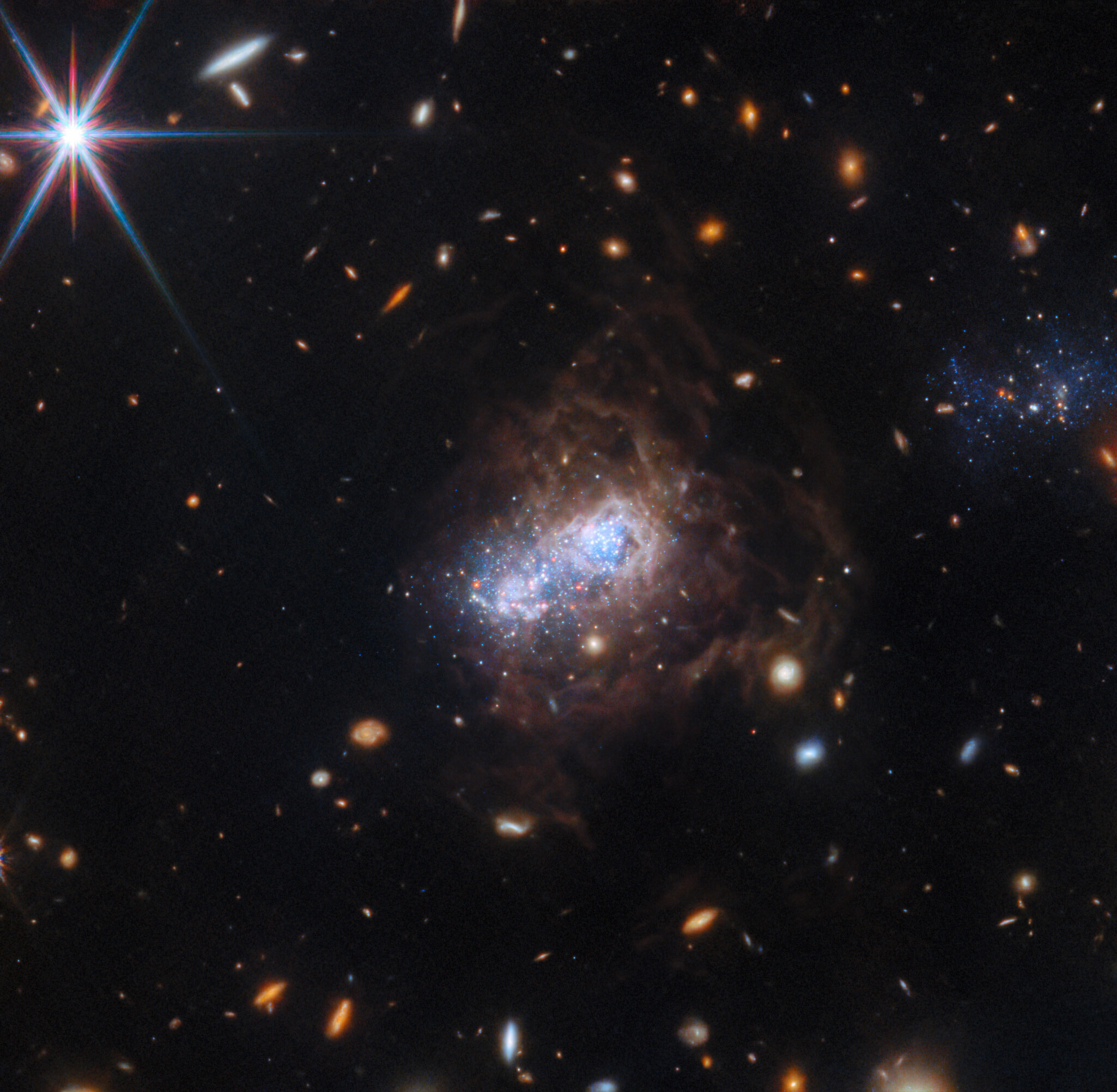
I Zw 18 (NIRCam). Credit: ESA/Webb, NASA, CSA, A. Hirschauer, M. Meixner et al.

Scientific Organizing Committee (SOC)

  • Angela ADAMO (Stockholm University, Sweden)
  • Guido DE MARCHI (ESA, Noordwijk, Netherlands)
  • Frédéric GALLIANO (CEA Paris-Saclay, France; chair)
  • Deidre HUNTER (Lowell Observatory, USA)
  • Rémy INDEBETOUW (University of Virginia, Charlottesville, USA)
  • Suzanne MADDEN (CEA Paris-Saclay, France; chair)
  • Daniel SCHAERER (Université de Genève, Switzerland)
  • Elizabeth TARANTINO (STScI, Baltimore, USA)
Loading... Loading...